Last December, we wrote that we weren't immediately planning a 2026 hackathon. We said we wanted to move deliberately, find the right partners, and build for the long term.
We did that. And it led us back here.
The Ayiti AI Hackathon returns November 27–29, 2026. Applications are open until October 18.
Here's what it is, what changed, and why you should apply.
What last year taught us
Forty-five people registered. Fifteen teams were selected. Eleven showed up and shipped working AI applications in 48 hours.
AgriBot detected crop diseases offline, in Kreyòl, on a basic phone. Patrol-X monitored community safety across WhatsApp, X, and local media. Braina.ai turned handwritten notes into study tools. Ayira built Kreyòl text-to-speech and speech-to-text from scratch.
Two projects went on to DevExpo. One was a finalist and is now building its platform.
The pattern was clear. Preparation matters. The teams that arrived with a clear problem, a plan, and a technical base had more room to build during the 48 hours.
The projects that stood out also had something else in common: they took Haiti's conditions seriously instead of treating them as an afterthought.
That became this year's theme.
The theme: AI beyond ideal conditions
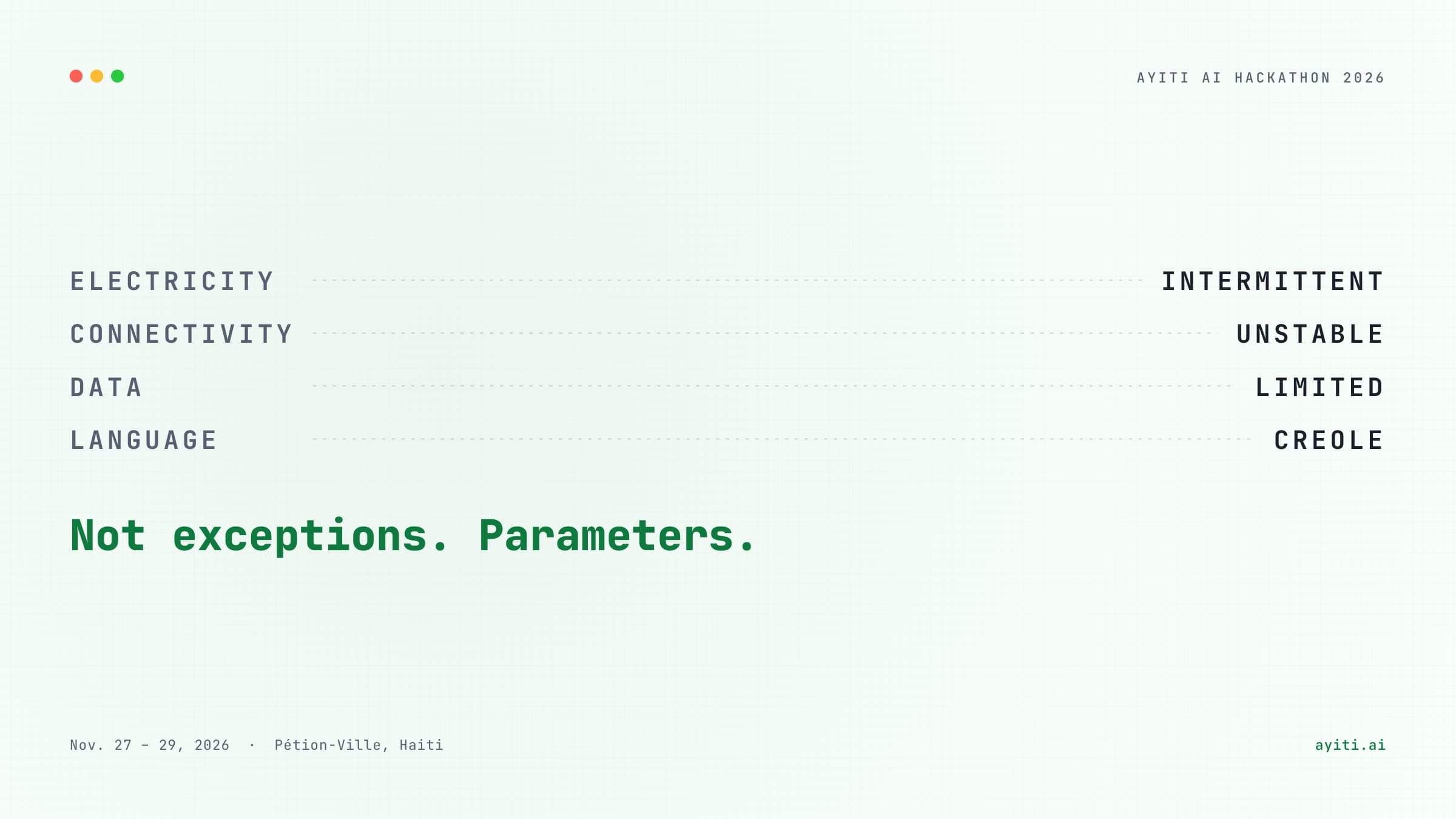
Many AI systems are developed in environments where electricity and internet connectivity are relatively stable, data is easier to access, and English is often the default language.
In Haiti, those conditions are not always guaranteed.
Usually, those constraints are treated as limitations. This year, we're asking teams to treat them as design parameters from the start.
Build AI systems that can keep working when the connection is weak, the power is intermittent, the data is scarce, and the user speaks Kreyòl.
Every project will answer three questions:
- Who in Haiti uses this?
- What happens when the infrastructure is limited?
- Why could this matter beyond Haiti?
It is not about doing less because conditions are difficult. It is about designing for the conditions as they are.
Six frontiers
Last year we had six themes — health, education, culture, and others. They were sectors.
This year we have six frontiers: specific problems and constraints where Haiti's reality creates a demanding environment for building, and where the underlying challenges are also being explored around the world.
Agents for the Real Economy. Much of Haiti's economy still runs on cash, memory, and WhatsApp, while relatively little software is designed around those realities. Build agents for small businesses, the informal economy, transport, payments, and remittances — through WhatsApp, SMS, voice, or local payment systems. A Kreyòl voice bookkeeper for a vendor. A stock agent for a neighborhood shop. An agent that helps a tap-tap owner track trips, fuel, and repairs.
Offline, Edge, and the Physical World. Electricity and connectivity are not always available. Build systems that run on phones, computers, sensors, and other devices, process information locally, and synchronize when a connection becomes available. An on-device vision model for crops or documents. A sensor system for a water tank or solar panel. An offline assistant for community health workers.
Kreyòl-Native, Voice-First. Many people in Haiti are more comfortable speaking than typing, while Kreyòl remains underrepresented in many AI tools and models. Build speech recognition, text-to-speech, translation, voice agents, or datasets that make AI more useful for Kreyòl speakers.
Resilience, Security, and Public Good. Insecurity takes many forms here — physical, food, health, and economic — as does the uncertainty of not knowing what is happening around you. Build systems that help people stay informed, coordinate resources, and respond when services or infrastructure are under pressure.
Learning Without Limits. Students prepare for NS4 and the bac with limited access to tutors, reliable electricity, or other learning resources. Teachers face many of the same constraints. Build tutors, teacher copilots, career tools, and learning experiences that fit Haiti's curriculum, languages, and infrastructure.
Open Track. An idea that doesn't fit the other frontiers. The rules are the same: solve a real problem for a defined user, account for limited infrastructure, have something functional at demo time, and show why the idea could matter beyond Haiti.
You choose one frontier when you apply. The choice is fixed. The project inside it can evolve during training — and usually does.
What's different this year
The call is open to developers across every department. Not only the capital. Training is online, so developers outside Port-au-Prince can prepare remotely before coming for the weekend. The hackathon itself remains fully in person.
Training is part of the program. There are four online Saturdays, from October 31 to November 21, covering what the frontiers actually require: AI agents, RAG, offline and edge AI, and Kreyòl voice. Sessions are available live and recorded. The training is not optional. Forty-eight hours is not enough time to learn new tools and build a product at the same time. The month before matters.
Judging changed. Last year, the focus was innovation, functionality, and presentation. This year, the jury will look at who the project serves, whether it continues to work when infrastructure is limited, whether it actually works at demo time, whether it could matter beyond Haiti, and the quality of the execution.
A working product is required to place. Projects will be made available online for the jury to evaluate before development ends. Presentations follow on Sunday afternoon.
There's a co-organizer. AyitiLab, the technology accelerator created by Fondation Avenir, is organizing this edition with us. That gives the teams a stronger connection to an ecosystem that can support them beyond the hackathon.
And more partners are joining. ElevenLabs is supporting a Best Kreyòl Voice Experience award and giving participants access to its voice platform. Banj is helping relay the call across the country and creating a bridge to the entrepreneurial ecosystem for teams that want to continue developing their projects.
More partners will be announced as their participation is confirmed.
What we're asking of you
This edition asks more from teams than the last one did. We're saying that plainly.
Apply as a team of two or three, with a frontier chosen and at least one person who can build. Take part in all four training Saturdays. Prepare before the weekend. Build during the 48 hours. And bring something that works on Sunday.
The standard is simple: come prepared, build during the hackathon, and make something that actually works.
What you get
You get a month of technical training focused on the tools and approaches behind the six frontiers. You get access to partner tools where provided. You get 48 hours of building with mentors in the room and a jury of practitioners from Haiti, the diaspora, and the international AI industry.
There will be prizes for the top three teams, one award for each frontier, and additional partner awards.
Your project will also be published on ayiti.ai. And for teams that want to continue after the weekend, we're working with AyitiLab and partners to create opportunities for further support.
We won't promise more than that.
Last year, we said we couldn't guarantee funding or a path to market. We didn't. What we promised, we delivered.
Same standard this year.
Apply
Applications close October 18, 2026, at 11:59 PM.
Selected teams will be notified by email and begin training on October 31.
Form your team. Pick your frontier. Apply at ayiti.ai.
If you don't have a team yet, join the Discord — that's where teams can connect and form teams. If you have questions, write to alo@ayiti.ai.
Last year, we wanted to see what Haitian developers could build in 48 hours. They did.
This year, we're asking what they can build when Haiti's real conditions become part of the design.
Come build for them.